
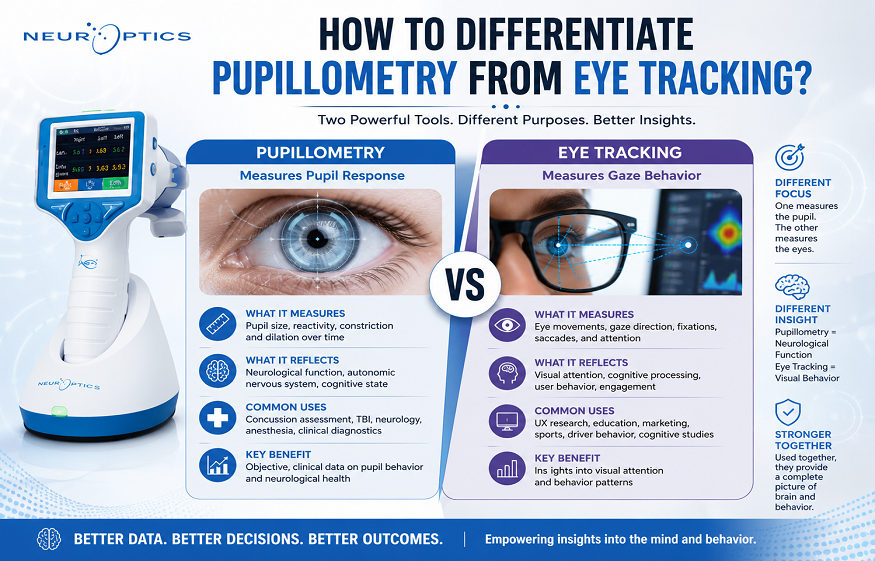
How to Differentiate Pupillometry from Eye Tracking?
Researchers often use pupillometry and eye tracking together, but they are not interchangeable. Pupillometry measures changes in pupil size and pupil reactivity, providing objective insight into autonomic and neurological function.
Eye tracking measures where and how the eyes move, helping researchers analyze visual attention, gaze behavior, and cognitive processing. Selecting the right technology depends on the scientific question being investigated.
What Is Pupillometry?
For researchers asking what pupillometry is, it is the objective measurement of pupil size and pupil reactivity before, during, and after a light stimulus or another experimental condition.
Modern digital pupillometers measure:
- Baseline pupil diameter
- Constriction latency
- Constriction velocity
- Dilation velocity
- Percentage of constriction
- NPi®
Because these measurements are objective and repeatable, pupillometry has become an essential part of pupil evaluation in scientific and clinical research.
Common research applications include:
- Neuroscience
- Psychology
- Sleep and fatigue studies
- Pharmacology
- Human factors research
- Animal research
- Brain injury investigations
What Is a Pupilometer?
For those asking what a pupilometer is, it is a device designed to measure pupil size and the pupillary light reflex with greater precision than manual observation. Digital systems reduce observer variability by producing standardized, objective measurements. Many research laboratories use monocular or binocular systems for both human and animal studies.
What Is Eye Tracking?
Eye tracking records eye movements rather than pupil physiology. It measures:
- Point of gaze
- Fixations
- Saccades
- Smooth pursuit movements
- Blink frequency
- Visual attention patterns
These measurements support research in:
- Human-computer interaction
- Consumer behavior
- Reading studies
- Driving simulation
- Virtual reality
- Marketing research
- Cognitive science
Although some eye trackers estimate pupil diameter, their primary purpose is understanding gaze behavior rather than conducting neurological pupil evaluation.
Read More: The Three Types of ADHD, and How to Tell Which One Fits You
How Does Pupillometry Differ From Eye Tracking?
| Feature | Pupillometry | Eye Tracking |
| Primary measurement | Pupil size and light reflex | Eye position and movement |
| Main purpose | Assess autonomic and neurological function | Analyze visual attention and gaze behavior |
| Common output | Pupil diameter, constriction velocity, NPi® | Fixations, saccades, gaze paths |
| Typical use | Neurological research, pharmacology, brain injury studies | Psychology, usability testing, consumer research |
| Physiological focus | Pupil reactivity | Eye movement patterns |
For example, research on pupillary response in traumatic brain injury requires precise measurement of pupil dynamics. In contrast, reading comprehension or usability studies depend on fixation duration and gaze transitions. The research objective, not the equipment available, should determine which technology is used.
Expert Insight: Why Objective Pupillometry Has Become an Essential Neurological Tool
Manual flashlight examinations remain common during a neuro exam, but quantitative pupillometry provides more consistent and reproducible measurements.
| Research Finding | Why It Matters |
| Studies have reported substantial inter-observer variability during manual pupil assessments. | Objective digital measurements reduce subjectivity and improve repeatability across examiners. |
| Quantitative pupillometry can detect small changes in pupil function that may not be visible during a standard visual assessment. | Researchers obtain more sensitive and reproducible physiological data for pupil exam. |
| Multiple studies involving acute neurological injury have found that abnormal NPi® values are associated with poorer neurological outcomes. | Standardized measurements improve consistency in neurological research and studies involving pupillary response in traumatic brain injury. |
Objective pupillometry is especially valuable for multicenter research because standardized measurements improve data consistency when comparing participants, monitoring interventions, and validating study outcomes.
Read More: Unlocking the Future of Life Sciences with Genomics & Bioinformatics APIs
When Should Researchers Choose Pupillometry Instead of Eye Tracking?
Choose pupillometry when studying:
- Objective pupil evaluation
- Autonomic nervous system activity
- Pupillary response in traumatic brain injury
- Neurological disorders
- Drug response
- Sleep, fatigue, or pain
- Animal pupillary reflexes
Choose eye tracking when studying:
- Visual attention
- Reading behavior
- Decision-making
- User experience
- Human-computer interaction
- Consumer behavior
- Gaze patterns during cognitive tasks
Many neuroscience studies combine both technologies. Eye tracking reveals where participants are looking, while pupillometry measures physiological responses occurring during the task.
What Should Hospitals and Organizations Consider Before Selecting a System?
Before investing in neurological tools, they should evaluate:
- Measurement accuracy and repeatability
- Monocular or binocular capability
- Compatibility with existing research workflows
- Human and animal research support
- Data export for statistical analysis
- Ease of calibration
- Technical support and validation resources
Selecting equipment based on research objectives and treatment instead of cost alone often leads to stronger, more reproducible datasets.
Final Thoughts
Although both technologies rely on optical imaging, they measure different physiological signals. Pupillometry provides objective information about pupil reactivity and neurological function, while eye tracking explains visual attention and gaze behavior. Selecting the appropriate technology starts with defining the treatment, the research question, and the data needed to answer it.
For research organizations seeking advanced pupillometry solutions, NeurOptics provides monocular and binocular pupillometry instrumentation for human and animal research across a wide range of scientific and clinical applications. Its objective technology supports reproducible data collection, strengthens neuro exam protocols, and advances studies requiring accurate pupil evaluation.
Frequently Asked Questions
Are eye tracking and pupillometry indicators of dissociable latent decision processes?
Yes. Research shows they reflect different aspects of decision-making. Eye tracking captures visual attention and information sampling, while pupillometry measures changes in pupil diameter associated with cognitive effort, arousal, and autonomic nervous system activity. Together, they help researchers separate attention-related behavior from physiological responses during decision-making.
What are two key measures for eye tracking?
The two most common eye-tracking measures are:
- Fixations: Periods when the eyes remain focused on a specific location, indicating attention and information processing.
- Saccades: Rapid eye movements between fixation points that reveal visual search patterns and cognitive strategies.
Can pupillometry detect cognitive issues?
Pupillometry cannot identify cognitive disorders, but it can measure changes in pupil size that are associated with cognitive workload, attention, and mental effort. Researchers often use it alongside other assessments to better understand cognitive function and neurological responses.